Rummy How-To: Use a Two-Draw Recovery Plan
A recovery plan is useful when your first arrangement has stopped improving. Instead of holding every card while waiting for inspiration, decide what you need from the next two draws and what you will do if those draws fail. The plan is short enough for live play and specific enough to prevent endless commitment.
Begin by identifying the most important unfinished requirement. It might be a pure sequence, a missing member of a set, or a way to lower the value of unmatched cards. Write the requirement mentally as a range rather than a single fantasy: “Any of these three cards helps,” or “I need one of two ranks in this suit.” If the requirement has only one possible card, note that it is a narrow route.
Next, choose a fallback that can survive without the primary draw. The fallback could be splitting a partial sequence, using a joker in a defined role, or moving a card into a different group. It should be a legal and realistic alternative, not another version of the same hope. Decide which card becomes the likely discard if the first draw misses. This preserves time for the second decision.
On the first draw, check whether the new card improves the primary requirement or creates a stronger independent route. If it does neither, follow the planned discard unless new visible evidence changes the evaluation. On the second draw, reassess the entire hand rather than automatically taking the same line. Two missed draws are evidence that the route deserves less attention, even though they do not prove the needed card is unavailable.
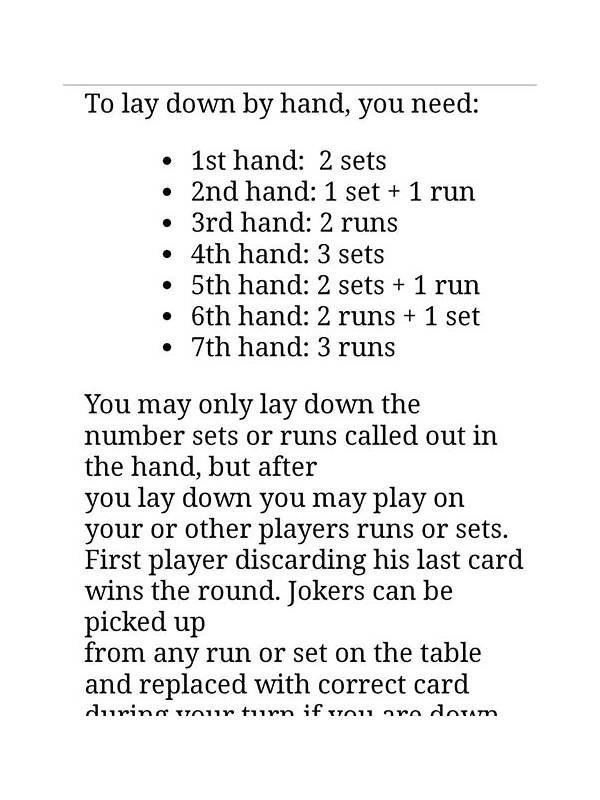
Keep score and table rules in view. In a high-penalty format, an early move toward lower unmatched value may be sensible. In a format where a valid declaration has special requirements, protect the required structure first. A recovery plan should support the rules, not replace them. If you are unsure whether a group is legal, pause and verify the rule before optimizing around it.
The plan works because it gives waiting a boundary. You can still change your mind when the hand changes, but you will know what evidence caused the change. Afterward, ask whether your first route had a real fallback and whether two draws were enough time to test it. This turns a frustrating miss into a repeatable planning habit.
If the hand changes dramatically during the two-draw window, cancel the original plan early. That is not a failure of the method. The window is a maximum testing period, while a strong new card is permission to reassess immediately. This distinction prevents a schedule from becoming another rigid commitment.